Someone once told me their welcome email gets a 62% open rate and their weekly newsletter gets 19%. Same list. Same sender. Same offer underneath. The only thing that changed was when the message arrived and why. That gap — 62 versus 19 — is the entire argument for email marketing automation in one number.
If you're new to this, here's the short version: automation means you write an email once, set a trigger, and the system sends it whenever a subscriber does something specific. Opens a link. Abandons a cart. Signs up on a Tuesday. You stop sending the same blast to ten thousand people and start sending the right message to one.
Key Takeaways
- Automation is a trigger plus a message. That's it. Everything else is decoration.
- Start with one flow: the welcome sequence. It's the highest-performing email most businesses ever send.
- Segmentation based on behavior beats segmentation based on demographics almost every time.
- Check your legal basis for sending before you build anything — consent rules are not optional.
- Over-automating is a real failure mode. If every email feels robotic, people unsubscribe.
- Measure open rate, click rate, and unsubscribe rate per flow, not per campaign.
Email marketing automation, explained without the jargon
A trigger fires. A message goes out. A condition decides what happens next. If you can describe those three things in a sentence, you can build an automation.
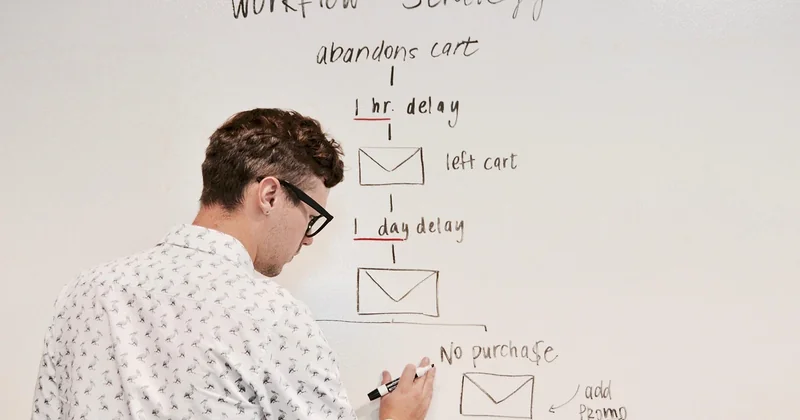
Take the abandoned cart. Someone adds a jacket to their cart, gets distracted, closes the tab. Twenty-four hours later, an email arrives: "Still thinking about it?" That email exists because of a trigger (cart abandoned), a delay (24 hours), and a message (the nudge). No human touched it.
What trips beginners up is assuming automation is complicated software. It isn't. The software is the easy part. The hard part is knowing what to say and when.
What is email automation?
Email automation is the practice of sending messages based on subscriber behavior or timing rather than manual effort. You define the conditions once. The platform handles delivery forever after.
The distinction that matters: a campaign is something you send to your list. An automation is something your list triggers for themselves. That shift in direction changes everything about how people respond.
The five flows every beginner should build first
You do not need forty automations. You need five, done properly. I've watched people spend a month mapping an elaborate branching system and never launch the welcome email. Don't be that person.
1. The welcome sequence
Triggered when someone joins your list. Typically three to five emails over ten days. This is where you set expectations, deliver whatever you promised, and introduce what you actually sell.
2. Abandoned cart
For anyone selling physical or digital products, this single flow often recovers more revenue than every newsletter combined. Two emails usually beat three — the third starts to feel like nagging.
3. Post-purchase follow-up
Buyers are your warmest audience and the most neglected. A thank-you, a usage tip, and a review request over two weeks costs you nothing to set up.
4. Re-engagement
Nobody on your list forever. If someone hasn't opened in 90 or 120 days, one honest email — "should I stop emailing you?" — will either wake them up or clean your list. Both outcomes are wins.
5. A birthday or milestone email
Sounds gimmicky. Performs annoyingly well. A small discount with a personal subject line gets opened because it's about them, not you.
Email automation examples you can copy today
Here are three I've actually run, with what happened.
A welcome email with one question. Instead of a long introduction, the first email asked: "What are you trying to solve?" One reply option, one click. The replies told me exactly which segment each person belonged in, and I routed them accordingly. Click-through on that single email ran roughly three times higher than my standard newsletter.
A win-back flow with a deadline. Three emails over nine days, the last one offering a discount that expired in 48 hours. The urgency did the work. About one in six lapsed subscribers came back — not spectacular, but the flow runs on its own and costs me nothing per conversion.
A post-purchase tip series. Four emails teaching people how to use what they bought. Refund requests dropped noticeably in the first month. That was the real win, not the upsell I'd bolted on at the end.
Email automation tools: what actually matters
You will read a hundred tool comparisons. Most rank features you'll never touch. Here's what actually decides whether you stick with a platform.
| What to check | Why it matters | Beginner-friendly signal |
|---|---|---|
| Trigger variety | Determines which flows you can build | Can you trigger on link clicks and page visits, not just signups? |
| Conditional logic | Lets one flow branch for different segments | Does the editor show a visual map? |
| Deliverability reputation | A cheap tool that lands in spam is expensive | Does it handle authentication for your domain? |
| Contact-based pricing | Costs scale with your list, not your sends | Is the price predictable as you grow? |
| Export options | You will want to leave one day | Can you pull your list and flows out cleanly? |
Mailchimp, Kit, Brevo, MailerLite — they all handle the basics. The honest answer is that for a beginner, the platform matters far less than the copy inside your first flow. I've seen a well-written sequence in a free-tier tool outperform a badly written one in a five-hundred-dollar-a-month platform.
Can you run email automation for free?
Yes, with limits. Most platforms offer a free tier that covers a few hundred to a couple thousand contacts and basic automation. The trade-off is usually logic complexity and support. You can absolutely launch your first welcome flow without paying anything, then upgrade once it's earning.
The mistakes that kill beginner automations
Automation fails in predictable ways. None of them are technical.
- Sending without a legal basis. Depending on where your subscribers live, you may need explicit opt-in consent, a clear unsubscribe link, and a real physical address in the footer. Get this wrong and you're not just annoying people — you're exposed.
- Building before writing. The most common stall. People configure triggers for a week and still haven't written the email.
- Treating every subscriber the same. If your welcome flow is identical for a first-time browser and a repeat buyer, you're wasting the trigger.
- Automating the personality out. The catch with automation is that consistency without warmth reads as spam. Write like a person, even when a machine sends it.
- Forgetting to check the mobile preview. Half your list reads on a phone.
The deliverability issue deserves its own mention because beginners underestimate it enormously. If you buy a list, or send to people who never asked, your domain reputation drops. Once it drops, even your good emails land in spam. There's no quick fix — you rebuild trust over months. Don't buy lists.
Where to start this week
Pick one flow. Write three emails. Set the trigger. Send it to yourself first.
That's genuinely the whole beginner's guide compressed into three sentences. The people who succeed at this aren't the ones with the cleverest platform or the longest flow map — they're the ones who shipped something imperfect in week one and improved it in week two.
The 62% open rate I mentioned at the start didn't come from a fancy tool. It came from a message arriving at the exact moment someone had just raised their hand. You can build that this weekend. Whether you do is the only question that matters.